~$ man ia-multimodale
What is multimodal AI?
definition
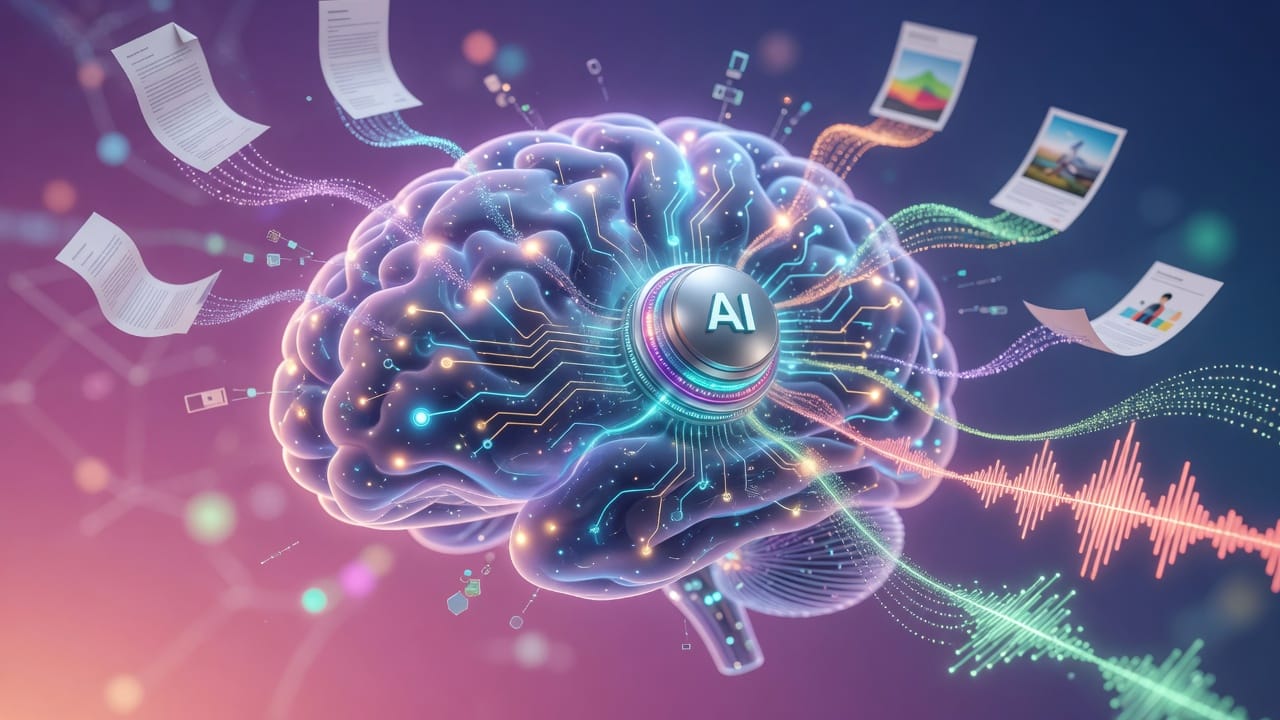
Multimodal AI refers to models that accept and generate outputs across several data types such as text, images, audio, and video within one system.
These models align and fuse information from each modality during training and inference, enabling tasks that single-modality models cannot perform alone.
Think of multimodal AI as a student who reads a textbook page, watches a diagram video, and hears the teacher explain the same idea, then links all three sources to understand the topic fully.
key takeaways
- Multimodal AI accepts and combines text, images, audio, and video inputs.
- It supports tasks such as image captioning, video question answering, and speech-driven image generation.
- Training requires paired datasets across modalities and extended transformer architectures.
- Alignment of features from different data types remains a core technical challenge.
- Current examples include models that extend language transformers with vision encoders.
the 2026 job market
In 2026 demand grows for engineers who can build and fine-tune multimodal systems in robotics, healthcare imaging, and automated content tools, creating roles in applied research and production deployment.
frequently asked questions
How does multimodal AI work?
It uses separate encoders for each data type then merges the resulting vectors in a shared space so the model can reason across modalities at once.
What are common examples of multimodal AI?
Systems such as vision-language models that describe photos, answer questions about videos, or generate images from text prompts.
What data is needed to train multimodal AI?
Large paired datasets that link images with captions, audio with transcripts, or video clips with descriptions are required for alignment.
Which industries use multimodal AI today?
Healthcare for medical image reports, automotive for sensor fusion, and media for automated video editing and captioning.