~$ man reinforcement-learning
What is reinforcement learning?
definition
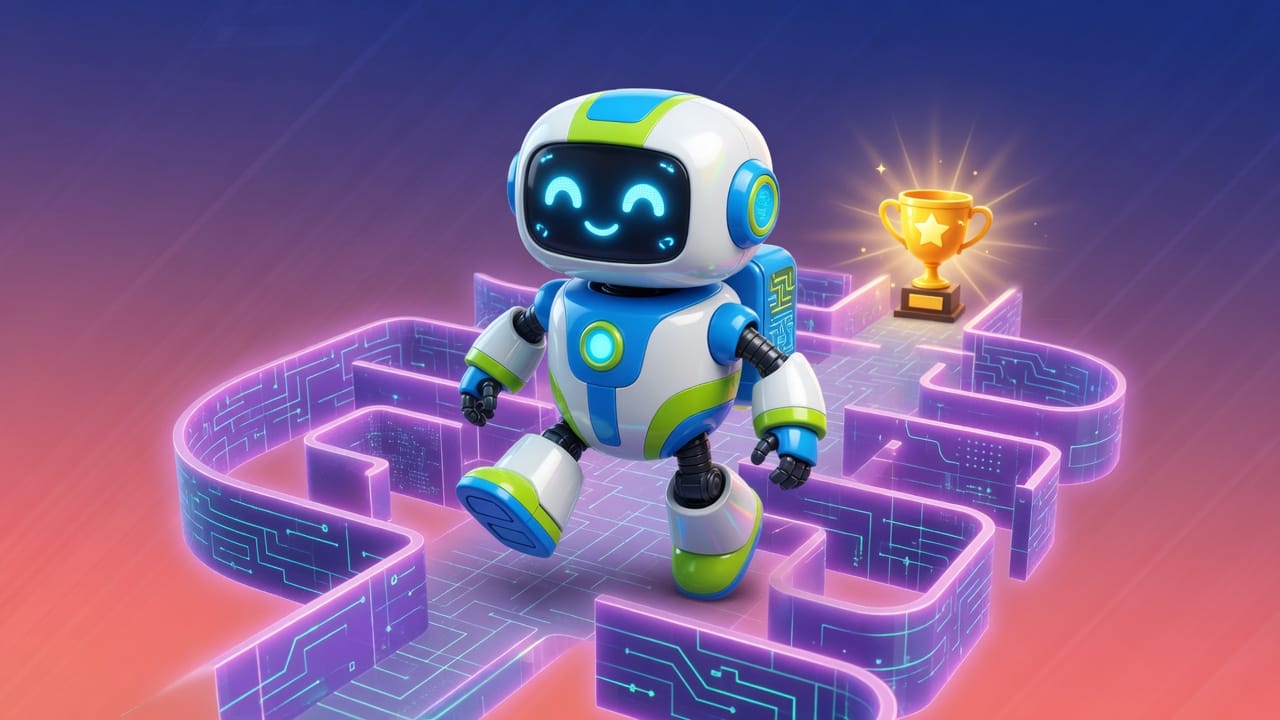
Reinforcement learning is a type of machine learning where an agent learns to make decisions by interacting with an environment and receiving rewards or penalties.
The agent follows a policy to choose actions, observes outcomes, and updates its strategy to maximize cumulative reward over time. Key elements include the agent, environment, reward function, and value estimation.
It differs from supervised learning because it does not rely on labeled examples and instead discovers optimal behavior through exploration and feedback.
A person learning to play chess improves by playing games, noting which moves lead to wins or losses, and gradually choosing better moves without step-by-step instructions from a coach.
key takeaways
- Reinforcement learning uses rewards instead of labeled data to guide learning.
- It powers systems that need sequential decisions such as game playing and robot control.
- Core algorithms include Q-learning, deep Q-networks, and policy gradient methods.
- A central challenge is balancing exploration of new actions with exploitation of known good actions.
- Training often requires large numbers of interactions, making simulation environments common.
the 2026 job market
Demand grows for engineers who can apply reinforcement learning to robotics, logistics optimization, and recommendation systems as firms move from research prototypes to production decision-making agents in 2026.
frequently asked questions
How does reinforcement learning differ from supervised learning?
Supervised learning trains on labeled examples while reinforcement learning learns from rewards received after actions. No direct correct answers are provided during training.
What are common real-world uses of reinforcement learning?
Applications include training game agents, controlling robotic arms, optimizing data center cooling, and managing inventory in supply chains.
Why is exploration versus exploitation important in reinforcement learning?
The agent must try new actions to discover better strategies while also using actions already known to give high rewards. Poor balance leads to suboptimal or slow learning.
What skills are needed to start working with reinforcement learning?
Strong Python, probability, and neural network knowledge form the base. Familiarity with frameworks such as Stable Baselines or RLlib helps practitioners run experiments quickly.