Overfitting and Generalization: How Can Your AI Really Learn?
Understand overfitting, its causes, and simple techniques to improve the generalization of your AI models.
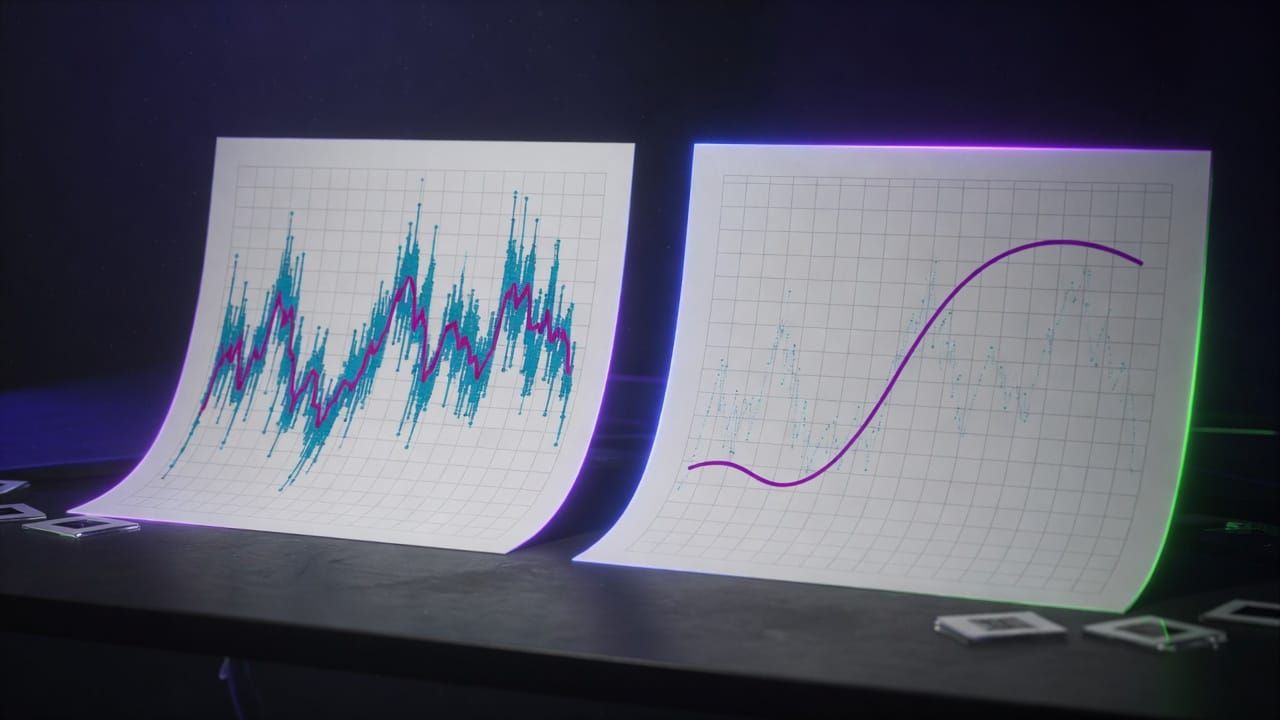
Imagine a student who memorizes all the answers in a textbook by heart without understanding the concepts: they will ace exercises they've already seen, but will fail when faced with new questions. This is exactly what happens with overfitting in artificial intelligence. This phenomenon, also called overfitting, prevents models from being truly useful in real life. Let's explore together how to detect and correct it so that your algorithms generalize correctly.
What is overfitting?
Overfitting occurs when a machine learning model fits the training data too precisely, including noise and exceptions. Instead of learning general patterns, it memorizes specific examples. As a result, it achieves excellent performance on the data seen during training, but performs poorly on new data.
- The model becomes too complex relative to the amount of data.
- It captures statistical noise rather than real trends.
- Performance drops sharply on unseen data.
Why Does Overfitting Occur?
Several factors contribute to this problem. A model that is too powerful (with many parameters) when faced with limited data tends to overfit. Similarly, training for too long allows the model to adjust its weights to the smallest details. Finally, non-representative or noisy training data makes the situation worse.
- Model too complex (e.g., a very deep neural network).
- Dataset too small or lacking variety.
- Absence of regularization techniques.
Generalization: the primary objective
Generalization refers to a model’s ability to perform well on data it has never seen. This is the true criterion for success in AI. A model that generalizes well has learned the underlying rules rather than the examples themselves. To measure this capability, a test set separate from the training data is systematically used.
How to Detect Overfitting?
The simplest method is to compare performance on the training data and on a validation set. If the training error decreases continuously while the validation error increases, this is the classic sign of overfitting. You can also plot the learning curves to spot this discrepancy.
Effective Techniques to Improve Generalization
Fortunately, many solutions exist. Cross-validation, dropout in neural networks, L1/L2 regularization, or data augmentation help limit overfitting. Reducing model complexity or collecting more data is also very effective.
- Use cross-validation to evaluate robustness.
- Apply dropout or regularization.
- Increase data or simplify the model.
from sklearn.model_selection import train_test_split
X_train, X_test, y_train, y_test = train_test_split(X, y, test_size=0.2)
By applying these best practices, you will help your models move from the "parrot" stage to that of a truly intelligent learner.
💬 Have a question or want to go further? Join the community on Discord: https://discord.gg/GwhUKccQcM