Neural Networks Explained Simply: The Brain Behind AI
Discover how neural networks imitate the human brain to solve complex problems in artificial intelligence.
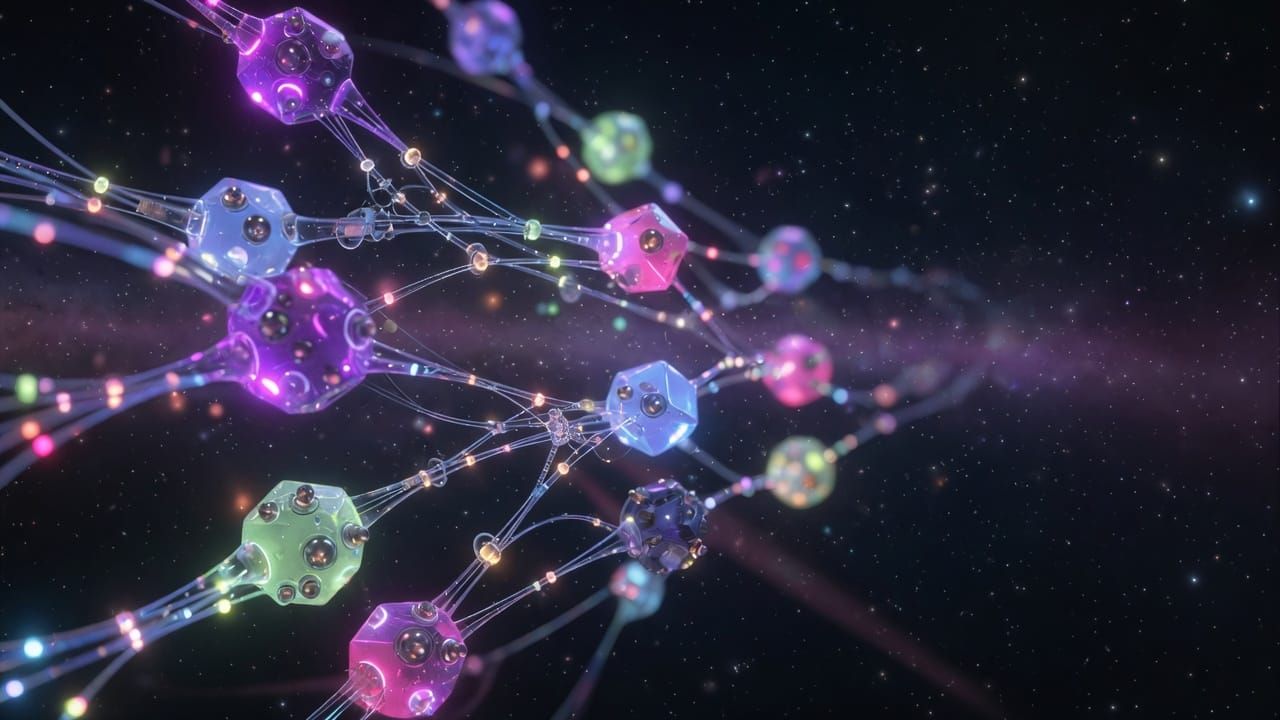
Neural networks are at the heart of many advances in artificial intelligence, from voice assistants to self-driving cars. For beginners, they may seem mysterious, but they rest on simple principles inspired by the human brain. This article guides you step by step to understand how they work, with concrete examples.
An Inspiration from the Human Brain
Artificial neural networks are directly inspired by biological neurons. Each neuron in our brain receives signals, processes them, and transmits a response. In AI, we reproduce this mechanism to allow a machine to learn from data.
- The human brain contains approximately 86 billion connected neurons.
- An artificial network uses mathematical “neurons” to process information.
- This analogy allows AI to recognize faces or translate texts.
The Basic Building Blocks: The Artificial Neuron
An artificial neuron, or perceptron, receives multiple inputs, applies weights to them, and produces an output. It's like a mini decision-maker that evaluates whether a piece of information is important or not.
- The inputs are data, for example the pixels of an image.
- The weights determine the importance of each input.
- An activation function decides whether the neuron "fires" or not.
How does a network learn?
Learning occurs through the gradual adjustment of weights. Examples are presented to the network, its response is compared to the correct answer, and errors are corrected. This process is called backpropagation.
- The training data serves as a "teacher".
- Errors are measured with a loss function.
- After thousands of examples, the network becomes accurate.
Practical applications in everyday life
Neural networks are everywhere. They recognize your voice on your smartphone, filter spam in your emails or recommend videos on streaming platforms.
- Image recognition in photo applications.
- Automatic translation like Google Translate.
- Fraud detection in banking transactions.
The Main Types of Networks
There are several architectures suited to different problems. Convolutional networks excel with images, while recurrent networks handle sequences such as text or speech.
- Convolutional Networks (CNN) for vision.
- Recurrent Networks (RNN) for language.
- Transformers for modern models like ChatGPT.
Experimenting on Your Own
You can test a neural network without expensive hardware thanks to libraries like TensorFlow or PyTorch. Start with a simple image classification example.
import tensorflow as tf
model = tf.keras.Sequential([
  tf.keras.layers.Dense(128, activation='relu'),
  tf.keras.layers.Dense(10, activation='softmax')
])
Train this model on a dataset like MNIST to recognize handwritten digits.
Neural networks open up a fascinating world of intelligent applications. By understanding their basics, you are ready to explore further and create your own AI projects. Don't hesitate to test and learn by doing!
💬 Have a question or want to go further? Join the community on Discord: https://discord.gg/GwhUKccQcM