Neural Networks Explained Simply: The Brain of AI
Discover how neural networks, inspired by the human brain, allow machines to learn and recognize images or text.
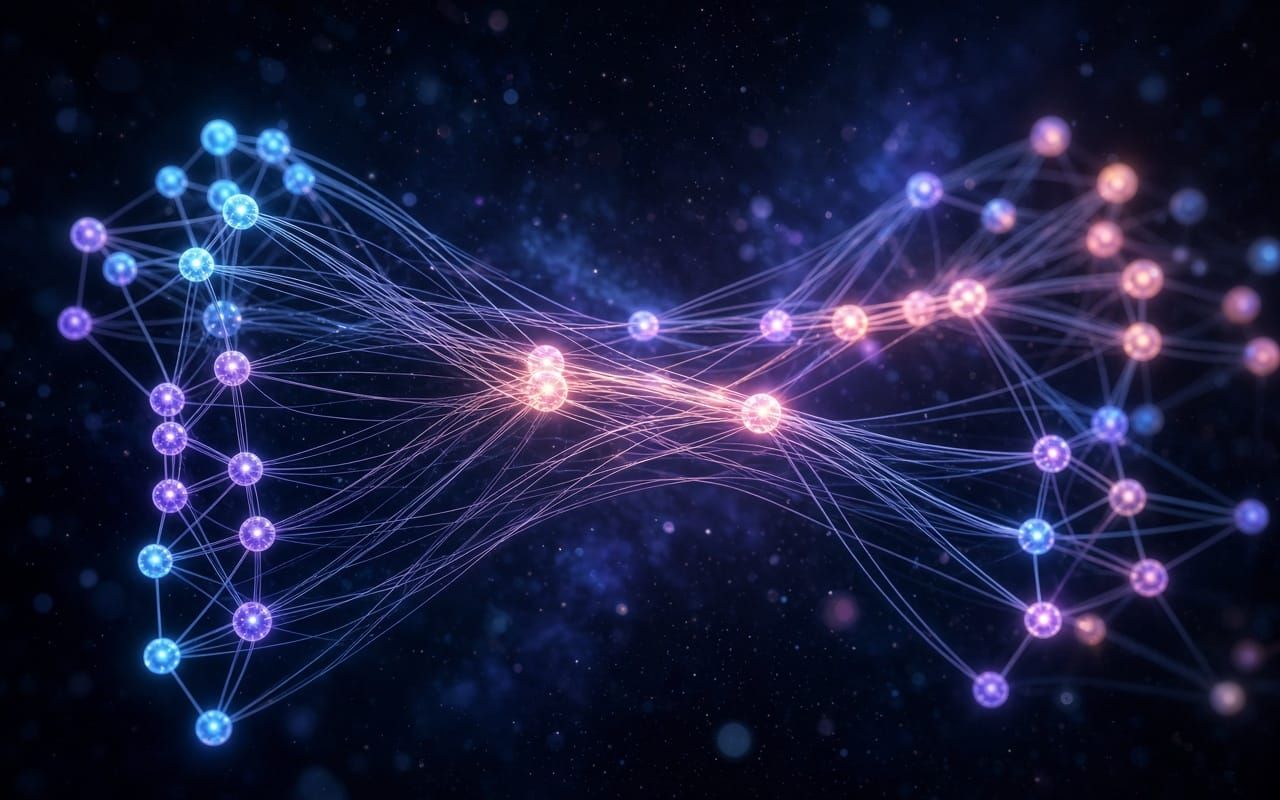
Neural networks are at the heart of modern artificial intelligence. They enable computers to learn from data, such as recognizing a cat in a photo or translating a sentence. For beginners, understanding how they work opens the door to many practical applications in AI.
What is a neural network?
An artificial neural network is a mathematical model inspired by the human brain. It is composed of units called artificial neurons that process information and transmit signals. Unlike a traditional program that follows fixed rules, a network learns patterns from examples.
- It mimics the connections between biological neurons.
- It excels at tasks like vision or language.
- It requires a lot of data to function well.
Basic Components: Neurons and Layers
Each neuron receives inputs, multiplies them by weights, adds a bias, and applies an activation function to decide whether it activates. Neurons are organized into layers: an input layer, hidden layers, and an output layer.
- The input layer receives the raw data, such as the pixels of an image.
- The hidden layers transform this data to extract features.
- The output layer produces the final response, such as a class probability.
How Does a Network Learn?
Learning occurs by adjusting the weights through a process called backpropagation. The network's output is compared to the expected answer, and errors are corrected by propagating backward through the layers. This is repeated over many examples until the model improves.
- The weights represent the importance of each connection.
- The loss function measures the difference between prediction and reality.
- The optimizer, such as gradient descent, updates the parameters.
A Concrete Example of Use
Imagine a network that classifies images of fruit. It is shown thousands of photos of apples and bananas along with their labels. After training, it can correctly identify a new photo. This principle applies to bank fraud detection or movie recommendations.
- The training data must be varied and of high quality.
- The deeper the network, the more complex patterns it can learn.
- Tools like TensorFlow or PyTorch simplify the creation of these models.
The challenges and how to get started
Neural networks require a lot of computation and can overfit if the data is insufficient. To get started, try online tutorials with simple datasets like MNIST for handwritten digits. Experiment with pre-trained models before building everything from scratch.
In summary, neural networks are transforming the way machines perceive the world. With practice and accessible resources, any beginner can explore this exciting field and create their first AI models.
💬 Have a question or want to go further? Join the community on Discord: https://discord.gg/GwhUKccQcM