Diffusion Models: How AI Turns Noise Into Stunning Images
Discover the simple and powerful workings of diffusion models, the technology behind Stable Diffusion and DALL-E.
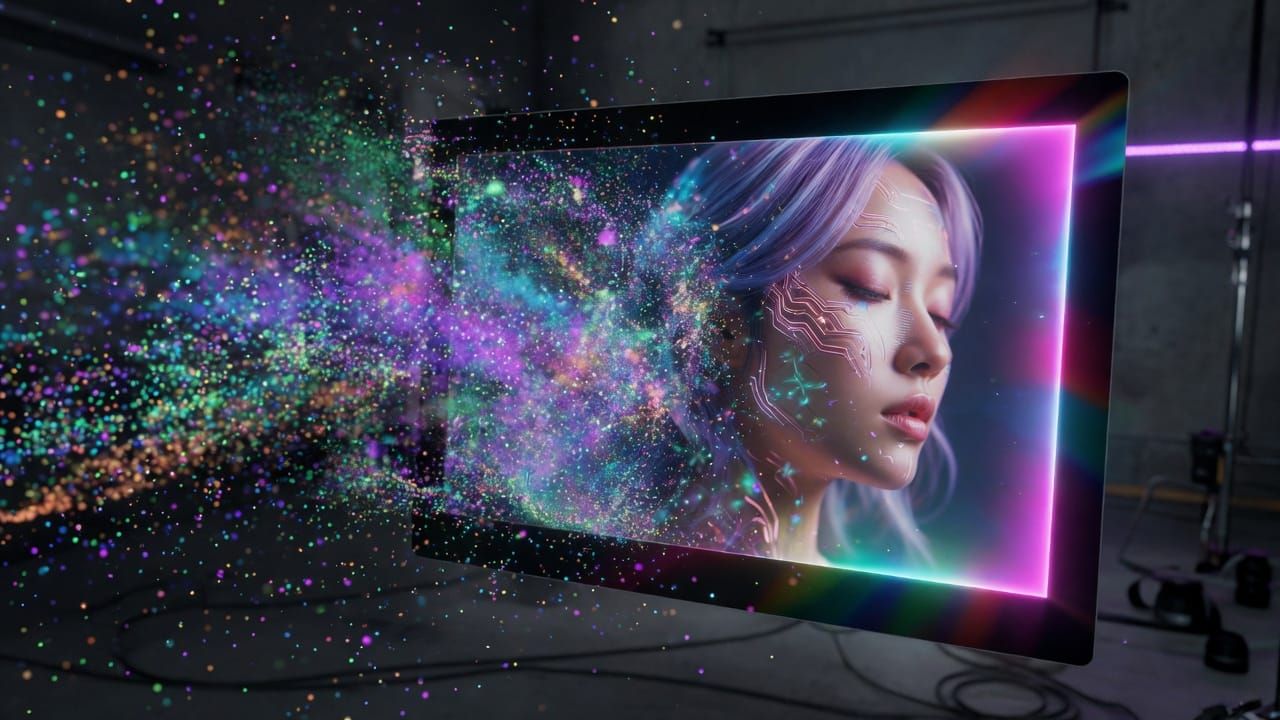
Imagine transforming a screen full of white noise into a realistic photo of a cat on a beach in just a few seconds. That's exactly what diffusion models do, a family of AI techniques that has revolutionized image generation. Unlike older approaches like GANs, these models learn to progressively "denoise" an image, offering more stable and higher-quality results. In this article, we'll explore how they work in a concrete way, without complex equations, so you can understand and even test these tools.
What is a diffusion model?
A diffusion model is a machine learning system that generates data (often images) by reversing a degradation process. It draws inspiration from the physical phenomenon of diffusion, like a drop of ink dispersing in water. The AI learns to reverse this process: starting from total chaos to reconstruct a coherent image.
- Key idea: add noise step by step until you obtain pure random noise.
- Then learn to remove this noise progressively.
- Result: sharp and creative images from a simple text description.
The two-step process: forward and reverse
The core of the model rests on two opposing phases. The “forward” phase consists of destroying the original image by adding Gaussian noise over hundreds or thousands of steps. The “reverse” phase is the one used in practice: the model predicts and removes the noise at each step to reconstruct the image.
- Illustrative example: imagine a photo of the Eiffel Tower. At step 1, a little grain is added; at step 500, it is almost invisible in the noise.
- The model learns to recognize “which noise to remove” at each level.
- This enables controlled, high-resolution generation.
How is a diffusion model trained?
Training is performed on enormous databases of annotated images. The model never sees the final image directly; it learns to predict the noise added at each step. Once trained, it can generate new images from pure noise, guided by a textual prompt.
- Conditioning: text embeddings are added (as with CLIP) to guide the generation.
- Example: the prompt "a fox in an autumn forest at sunset" guides the denoising.
- Advantage: the model can create infinite variants without copying the training data.
Concrete Examples and Popular Tools
Diffusion models have popularized accessible tools such as Stable Diffusion, Midjourney, or DALL-E 3. Being open-source, Stable Diffusion can run on a personal computer with a suitable graphics card. These tools enable the generation of illustrations, product concepts, or even medical images.
- Stable Diffusion: free and customizable via extensions.
- DALL-E: integrated with ChatGPT for simple use.
- Applications: graphic design, video games, visual education.
Advantages, Limitations and Best Practices
Diffusion models excel due to their stability and their ability to produce diverse images. However, they require significant computation and can sometimes generate artifacts or biases present in the training data. To use them effectively:
- Choose precise prompts and iterate multiple times.
- Use negative prompts to avoid certain elements.
- Always check the usage rights of open-source models.
How to Test a Diffusion Model Today
You can get started for free with online platforms or install Stable Diffusion locally via Hugging Face. Here is a simple Python code example to generate an image:
from diffusers import StableDiffusionPipeline
pipe = StableDiffusionPipeline.from_pretrained("runwayml/stable-diffusion-v1-5")
image = pipe("un panda faisant du skateboard à Paris").images[0]
image.save("panda.png")
Experiment with different prompts and parameters like the number of denoising steps to refine your results.
Diffusion models have made AI image creation accessible to everyone by transforming noise into impressive visual works. Whether you're an artist, developer, or simply curious, these tools open up infinite creative possibilities. Don't hesitate to try it yourself: the best way to learn remains practice!
💬 Have a question or want to go further? Join the community on Discord: https://discord.gg/GwhUKccQcM