Reinforcement Learning: When AI Learns Through Trials and Rewards
Discover reinforcement learning, a technique where AI improves by interacting with its environment like a curious child.
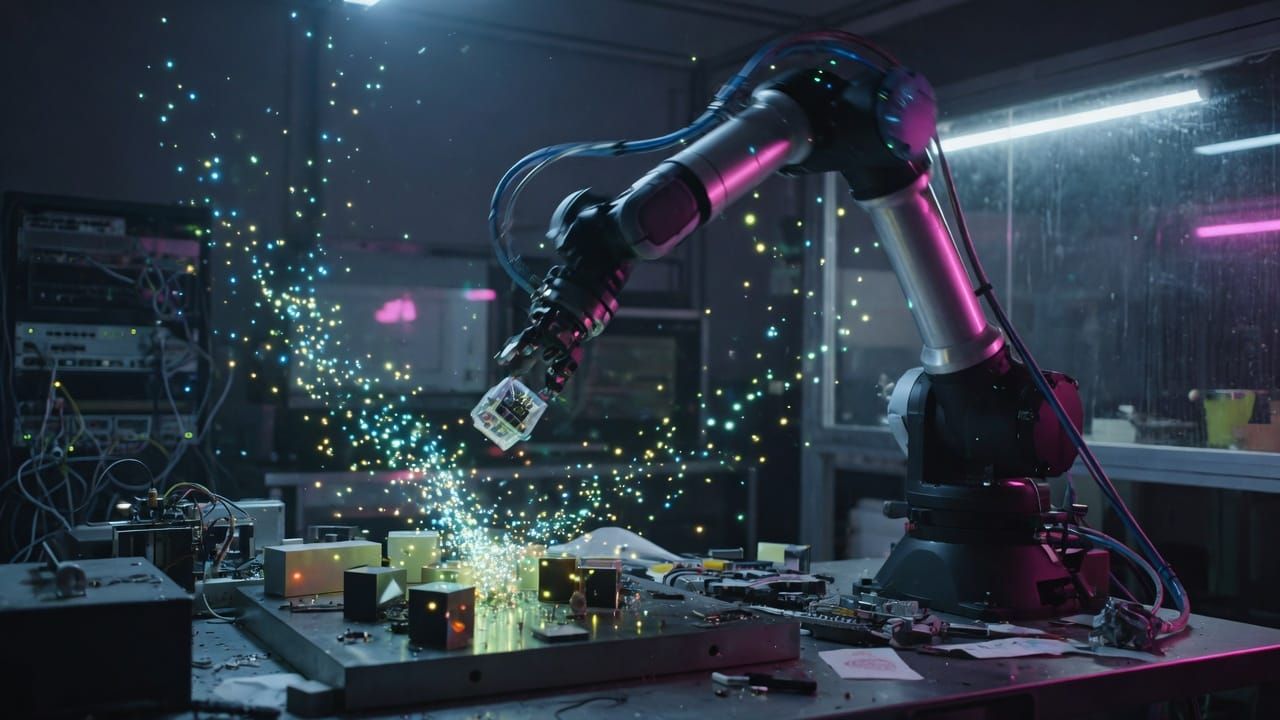
Reinforcement learning (RL) is one of the most fascinating branches of artificial intelligence. Unlike supervised learning which relies on labeled data, RL allows an agent to learn by itself through interactions, trial and error, guided solely by rewards. Imagine a puppy learning to fetch a ball: each time it succeeds, it receives a treat. This is exactly the principle that we transpose to a machine.
The Basics of Reinforcement
In RL, an agent operates in an environment and takes actions to achieve a goal. It does not receive direct instructions, but reward signals (positive or negative). The goal is to maximize cumulative reward over the long term. This approach mimics human learning through experience, such as when a child learns not to touch a hot stove after getting burned once.
The Essential Components
To understand RL, you need to master four key elements:
- The agent: the entity that makes decisions (a robot, a game program).
- The environment: the world in which the agent evolves (a maze, a game of chess).
- The actions: the possible choices at each step.
- The rewards: the feedback that indicates whether the action was good or bad.
These elements form a continuous loop: the agent observes, acts, receives a reward, and updates its strategy.
A Concrete Example with a Simple Game
Let's consider the example of an agent learning to play a maze game. At first, it explores randomly and frequently hits walls (negative reward). Gradually, it discovers the path to the exit (positive reward). After thousands of trials, it finds the optimal route. This process, called exploration-exploitation, allows the agent to test new strategies while exploiting those that already work.
Real and Impressive Applications
RL has already produced spectacular results. DeepMind's AlphaGo defeated the world Go champion in 2016. Robots learn to walk or grasp objects without explicit programming. In industry, RL optimizes supply chains, energy management, or content recommendations on streaming platforms. These successes show that RL excels in complex environments where the rules are not fully known in advance.
Challenges and How to Get Started
Despite its strengths, RL remains computationally intensive and can be unstable during training. Rare or poorly defined rewards make learning difficult. To get started, libraries like Stable Baselines3 or OpenAI's Gymnasium make it easy to experiment. Here is a simplified example of a training loop:
for episode in range(1000):
    state = env.reset()
    while not done:
        action = agent.choose_action(state)
        next_state, reward, done = env.step(action)
        agent.learn(state, action, reward, next_state)
With these tools, any beginner can train an agent to play CartPole in just a few minutes.
In conclusion, reinforcement learning offers a powerful way to create autonomous systems capable of adapting to unforeseen situations. By starting with simple examples and understanding the concepts of agent and reward, you can quickly explore this exciting field and imagine your own innovative applications.
💬 Have a question or want to dive deeper? Join the community on Discord: https://discord.gg/GwhUKccQcM