Reinforcement Learning: The AI That Learns Through Trials and Rewards
Discover how reinforcement learning allows an AI to learn like a child by exploring and receiving rewards.
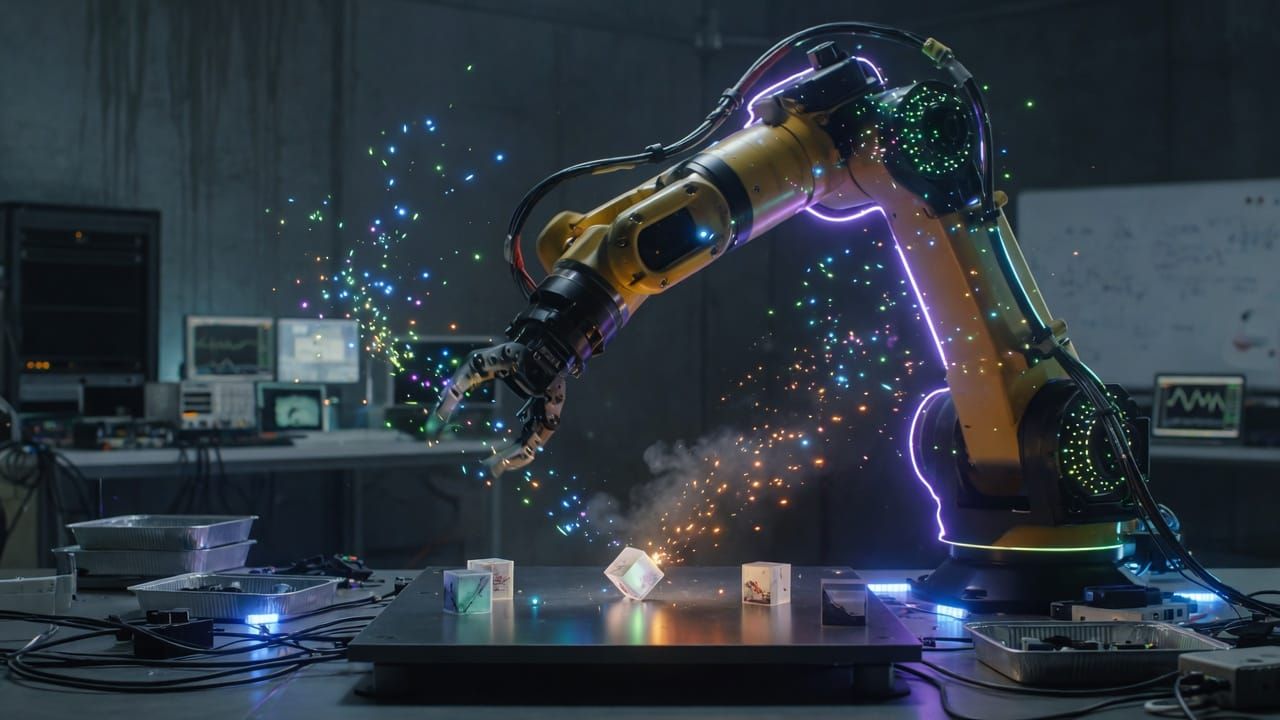
Reinforcement learning (RL) is an exciting branch of artificial intelligence where an agent learns to make decisions by interacting with its environment, much like a child discovering the world through trial and error. Unlike supervised learning, which uses labeled data, RL relies on rewards and penalties to guide the agent toward the best behaviors. In this article, we will explore its principles in a simple and concrete way.
The Fundamental Components of RL
Every RL system relies on three key elements that interact in a loop. The agent is the entity that makes decisions, such as a robot or a piece of software. The environment represents the world in which the agent operates, whether it is a video game or a factory. Finally, the reward is the signal that indicates whether an action was good or bad.
- The agent observes the current state of the environment.
- It chooses an action among several possibilities.
- The environment returns a new observation and a reward.
- The cycle repeats to maximize cumulative rewards.
A Concrete Example: Training an Agent to Play Pong
Let's imagine an agent learning to play Pong. At first, it hits the ball randomly and loses often. Each victory earns it +1 point and each defeat -1. Gradually, it associates certain paddle positions with positive rewards and refines its strategy. This process of exploration and exploitation allows the agent to become an expert without being explicitly told the rules of the game.
Key Algorithms: From Q-Learning to Modern Methods
Q-Learning is one of the most accessible algorithms for beginners. It involves building a value table (Q-table) that estimates the future reward for each action in each state. More advanced methods like DQN or PPO use neural networks to handle complex environments with millions of possible states.
import gym
env = gym.make('CartPole-v1')
# Simplified example: the agent chooses actions
# and updates its policy based on the rewards received.
Concrete Applications in Industry
RL is already used in many domains. Amazon's warehouse robots optimize their routes using rewards for speed and safety. In healthcare, algorithms help personalize treatments by maximizing efficiency while minimizing side effects. Autonomous cars also use it to learn how to anticipate the behavior of other road users.
Current Challenges and Limitations
Despite its successes, RL presents significant challenges. Exploration can be dangerous in real environments, and the agent often needs millions of trials before performing well. Additionally, poorly defined rewards can lead to unexpected behaviors, such as an agent that cheats instead of solving the real problem.
In conclusion, reinforcement learning offers a powerful path to creating autonomous AIs capable of adapting to unforeseen situations. By understanding its basics, you are ready to explore frameworks like Stable Baselines or Ray RLlib for your own projects. The future of RL looks rich in innovations, particularly in robotics and strategic games.
💬 Have a question or want to go further? Join the community on Discord: https://discord.gg/GwhUKccQcM