Unsupervised Learning: Discovering Hidden Groups with Clustering
Dive into unsupervised learning and learn how clustering reveals invisible structures in your data without any labels.
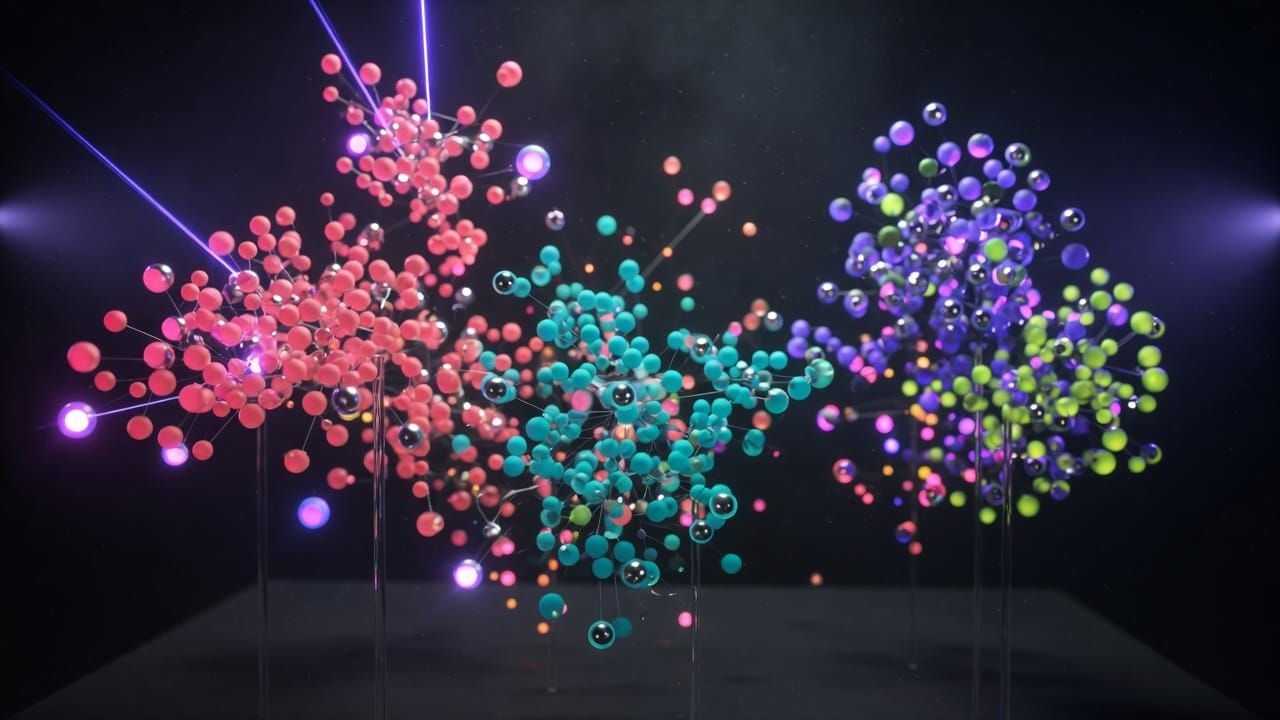
Unsupervised learning is a fascinating branch of artificial intelligence that enables machines to explore data without any prior human guidance. Unlike supervised learning, where algorithms learn from labeled examples, here the data arrives raw. Among its flagship techniques, clustering stands out by automatically grouping similar points, revealing hidden patterns such as customer segments or anomalies in medical images.
What is unsupervised learning?
In unsupervised learning, the algorithm analyzes the data on its own to extract structures. There are no labels or correct answers provided in advance. This makes it ideal for exploring large raw datasets, such as web navigation logs or IoT sensor readings. The main objective is discovery rather than prediction.
Clustering: Principles and Concrete Examples
Clustering involves partitioning a dataset into groups (clusters) where the elements within the same group are more similar to each other than to those in other groups. Imagine a supermarket that wants to group its customers: those who frequently buy organic products form one cluster, while snack enthusiasts form another. Another common example is grouping text documents to identify similar themes without manual reading.
- Customer segmentation for targeted marketing campaigns
- Gene clustering in biology to discover protein families
- Anomaly detection in banking transactions
The K-Means Algorithm in Detail
K-Means is the most popular clustering algorithm thanks to its simplicity. It requires choosing the number of clusters K in advance. The algorithm randomly places K centroids, assigns each point to the nearest centroid, then recalculates the positions of the centroids until convergence. It is an iterative method that works well on numerical and well-separated data.
from sklearn.cluster import KMeans
import numpy as np
X = np.array([[1, 2], [1, 4], [1, 0], [10, 2], [10, 4], [10, 0]])
kmeans = KMeans(n_clusters=2, random_state=0).fit(X)
print(kmeans.labels_)
Other Clustering Approaches
Beyond K-Means, hierarchical clustering builds a tree of clusters without setting K in advance, which is useful for visualizing relationships. DBSCAN, on the other hand, identifies clusters of arbitrary shapes and handles noise by detecting isolated points. These methods are better suited when the data exhibits variable densities or irregular shapes.
- Hierarchical Clustering: ideal for data with nested structure
- DBSCAN: robust to outliers and non-spherical shapes
- Gaussian Mixture Models: for overlapping clusters
Applications and Best Practices
Clustering is used in many domains: content recommendation, image compression, or social network analysis. For good results, normalize your data, choose the right number of clusters via the elbow method, and validate visually with graphs such as the silhouette plot. Remember that human interpretation remains essential to give meaning to the groups discovered.
In conclusion, unsupervised learning and clustering offer a powerful way to explore unlabeled data, paving the way for unexpected insights. By mastering these techniques, you will be able to transform raw datasets into actionable knowledge, a valuable asset for any modern AI project.
💬 Have a question or want to go further? Join the community on Discord: https://discord.gg/GwhUKccQcM