Unsupervised Learning: Discovering the Power of Clustering
Learn how clustering, the flagship technique of unsupervised learning, reveals hidden structures in your unlabeled data.
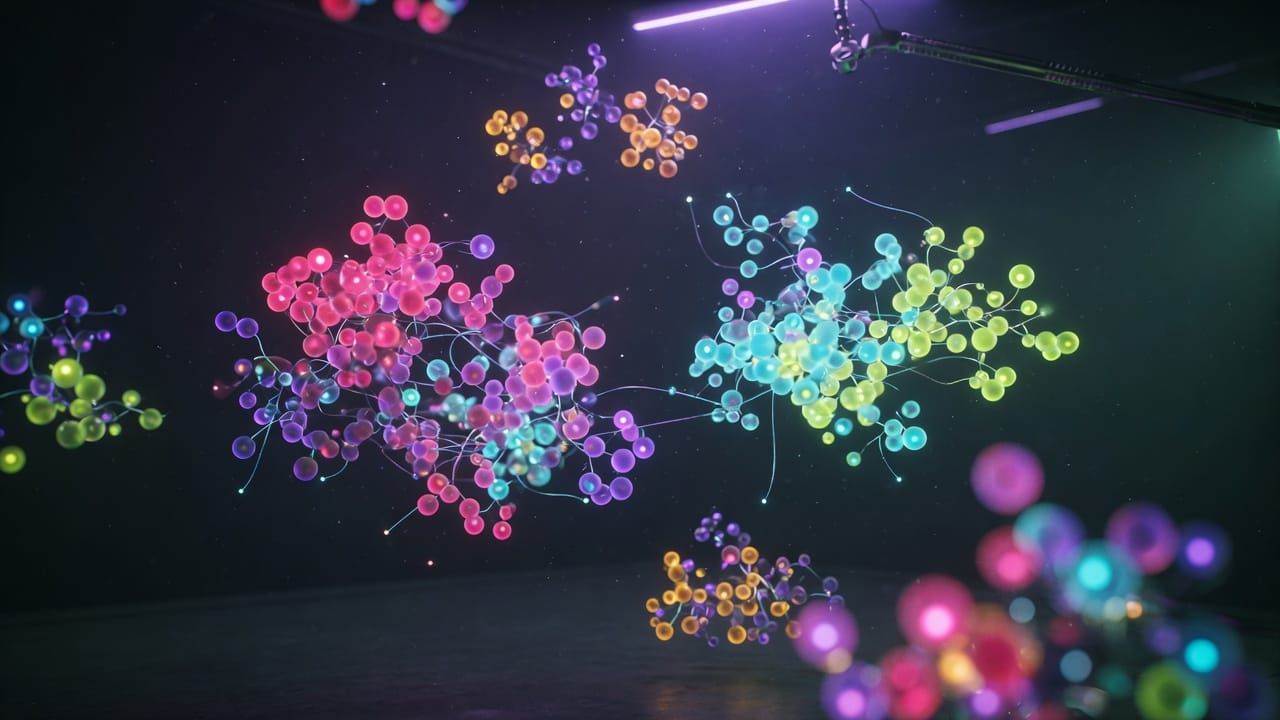
Imagine you have thousands of customer data points but no information about their behaviors. How can you organize them to understand them better? That's where unsupervised learning comes into play, and more specifically clustering. Unlike supervised methods that require labels, clustering allows you to automatically group similar data together. In this article, we'll explore this concept step by step, with concrete examples and practical tips for AI beginners.
What is unsupervised learning?
Unsupervised learning involves analyzing data without any prior information about the expected outcomes. The algorithm explores the data to identify hidden patterns or structures. Unlike supervised classification, there are no "correct answers" provided in advance. This makes it particularly useful for exploring large raw datasets.
- Discovery of natural groups in the data
- Reduction of the visual complexity of information
- Preparation of data for further analyses
Clustering: Grouping Without Labels
Clustering is the most popular unsupervised learning technique. It partitions data into subgroups (clusters) where points inside the same cluster are more similar to each other than to those in other clusters. For example, a company can group its customers according to their purchasing habits without knowing the segments in advance.
- Hierarchical Clustering: builds a hierarchy of clusters
- Density-Based Clustering: identifies dense regions in the data space
- Partitioning Clustering: like K-Means, divides into a fixed number of groups
The K-Means Algorithm Explained Simply
K-Means is the most widely used clustering algorithm thanks to its simplicity and efficiency. It works in three main steps: randomly selecting K centers, assigning each point to the nearest center, then recalculating the centers until convergence. The K parameter represents the desired number of clusters and must often be determined through trials or methods such as the Elbow Method.
- Centroid Initialization
- Assignment of Points to Clusters
- Iterative Update of Centers
Concrete Application Examples
In marketing, clustering enables customer segmentation into groups such as “frequent buyers” or “occasional customers.” In biology, it helps classify genes based on their expression. Social networks also use it to group users with similar interests, thereby improving recommendations.
- Customer segmentation in e-commerce
- Anomaly detection in banking transactions
- Document organization by themes
from sklearn.cluster import KMeans
import numpy as np

# Simple example with 2 features
data = np.array([[1, 2], [1, 4], [1, 0], [10, 2], [10, 4], [10, 0]])
kmeans = KMeans(n_clusters=2, random_state=0).fit(data)
print(kmeans.labels_)  # Displays the assigned clusters
Advantages, Limitations and Best Practices
Clustering is fast and intuitive, but it comes with challenges: choosing the number of clusters, sensitivity to outliers, and the assumption in K-Means that clusters are spherical. To get started on the right foot, normalize your data, test several values of K, and visualize the results with tools like PCA.
- Normalize variables before clustering
- Evaluate quality with the silhouette score
- Try several algorithms depending on the type of data
Clustering opens up fascinating possibilities for exploring your data without supervision. Starting with K-Means on simple datasets, you'll quickly build a solid intuition. Feel free to experiment with libraries like scikit-learn to turn your raw data into actionable insights.
💬 Have a question or want to go further? Join the community on Discord: https://discord.gg/GwhUKccQcM