Understanding Unsupervised Learning: Clustering Explained Simply
Discover how clustering reveals hidden groups in your data without any prior labels.
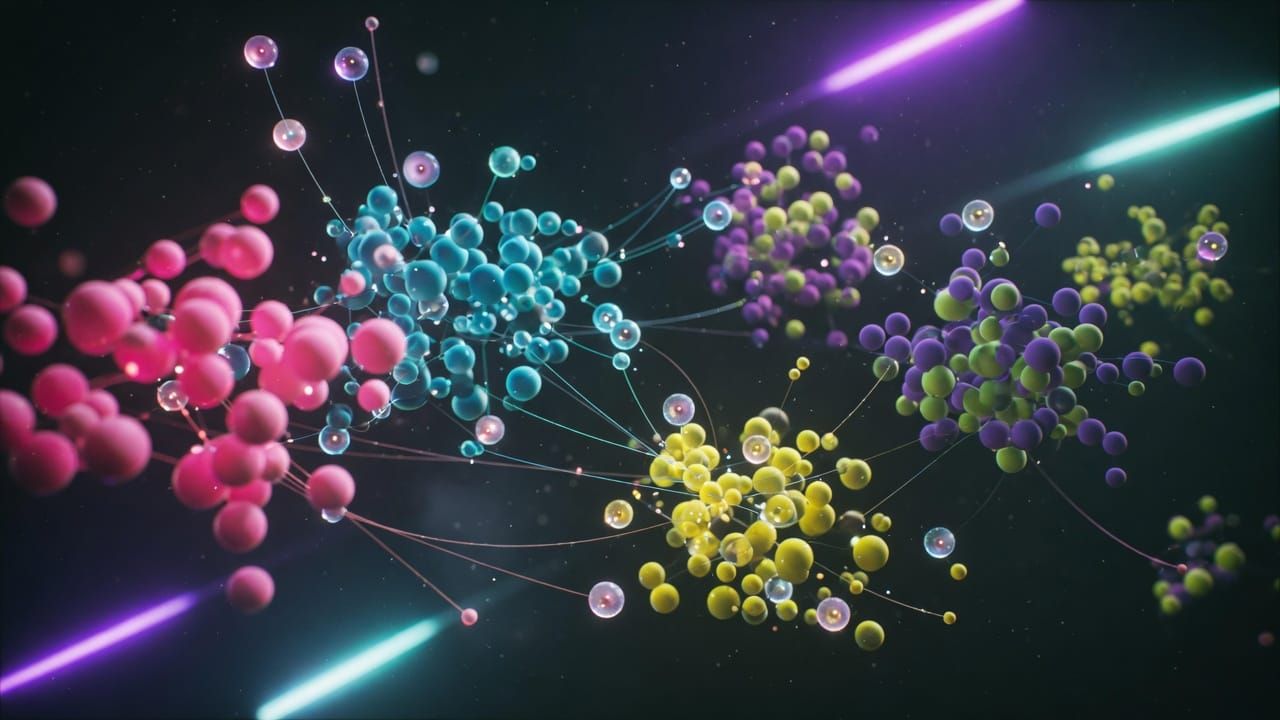
Unsupervised learning is a fascinating branch of artificial intelligence that allows machines to discover structures in the data without being told in advance what they should look for. Unlike supervised learning, where each example comes with a correct answer, here the algorithms explore on their own. Clustering, or grouping, is the most intuitive and widely used technique in this field.
What is unsupervised learning?
In unsupervised learning, the algorithm receives only raw data: photos, texts, measurements, or customer behaviors. Its goal is to identify patterns, similarities, or anomalies. It is used when we do not yet know what categories exist or when labels would be too costly to obtain.
- No known answers in advance
- Discovery of hidden structures
- Useful for data exploration and reduction
Clustering: grouping without labels
Clustering involves dividing a dataset into subgroups (clusters) where elements within the same group are very similar to each other, while the groups differ from one another. Imagine a store that wants to categorize its customers without knowing in advance whether they are “loyal,” “occasional,” or “premium”: clustering can automatically reveal these categories.
- Each data point is assigned to a cluster
- Clusters are defined by the similarity between points
- The number of clusters can be fixed or discovered automatically
The K-Means Algorithm, the Most Popular Tool
K-Means is the best-known and simplest clustering algorithm to understand. It works in three repeated steps: randomly select K centers, assign each point to the nearest center, then recalculate the centers as the mean of the assigned points. Repeat until the centers stop moving.
- Simple and fast on large datasets
- Requires choosing the number K of clusters in advance
- Sensitive to initial values and outliers
A Concrete Example: Customer Segmentation
An e-commerce company has the following data for each customer: average purchase amount, purchase frequency, and tenure. By applying K-Means, it can discover three natural groups: occasional small buyers, regular customers with medium budgets, and loyal big spenders. This information then allows it to personalize marketing campaigns without having manually labeled the customers.
Other methods and when to choose them
If K-Means assumes spherical clusters, other algorithms are more flexible. DBSCAN detects arbitrary shapes and ignores isolated points. Hierarchical clustering builds a tree of groupings, useful when you want to explore multiple levels of granularity. The choice depends on the shape of the data and what you are trying to discover.
- DBSCAN for data with noise and irregular shapes
- Hierarchical for visualizing relationships between clusters
- Gaussian Mixture Models for overlapping clusters
Real-World Applications and Best Practices
Clustering is everywhere: grouping documents for search, detecting bank fraud, segmenting medical images, or analyzing behaviors on social networks. To use it well, always start by normalizing your data, test multiple K values, and visualize the results with tools like t-SNE or PCA.
Clustering shows that AI can help us understand the world even when we don’t know exactly what we’re looking for. By exploring your data with these techniques, you transform tables of numbers into actionable insights and discover hidden opportunities.
💬 Have a question or want to go further? Join the community on Discord: https://discord.gg/GwhUKccQcM